
Why China Can Build Infrastructure Faster Than the United States
Across the world, a common question keeps resurfacing: why China can build infrastructure faster than the US, despite both countries possessing immense economic and technological resources. From sprawling high-speed rail networks to massive dams and entirely new cities, China’s physical transformation has unfolded at a pace that often feels impossible in Western democracies. Meanwhile, infrastructure projects in the United States—bridges, rail systems, energy pipelines, or even basic urban upgrades—frequently face years or decades of delays.
This contrast is not accidental, nor is it simply the result of better engineers, cheaper labor, or stronger ambition. At its core, the difference lies in governance. China vs US infrastructure is ultimately a story about how political systems distribute power, tolerate opposition, and define legitimacy.
Understanding this divide requires moving beyond slogans like “authoritarian efficiency” or “democratic paralysis” and instead examining how long-term planning, government authority, property rights, and public consent interact in two fundamentally different systems.
Why China Can Plan Infrastructure Decades Ahead
One of the most important reasons China long-term planning works at scale is political continuity. China operates under a single-party system where leadership transitions do not produce abrupt ideological reversals. National priorities are articulated through long-term visions—often spanning 15, 30, or even 50 years—and embedded into policy frameworks such as Five-Year Plans and long-range development goals.
When China commits to a national project, whether it is a high-speed rail corridor or a water diversion system, it does so with the assumption that the political environment supporting that project will remain intact. Ministries, provincial governments, state-owned banks, and industrial firms align around shared objectives rather than competing agendas.
This continuity allows China to absorb short-term costs for long-term gains. Projects that may not yield immediate political rewards can still proceed because leaders are not constrained by short election cycles. In contrast, democratic systems often struggle to justify investments whose benefits may only materialize long after current officeholders have left power.
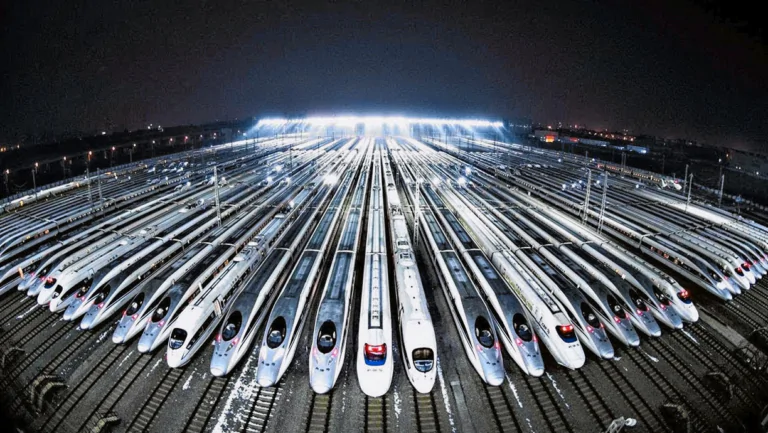
China’s high-speed rail network reflects the country’s ability to commit to long-term national planning.
Why US Infrastructure Projects Take So Long
To understand why US infrastructure projects take so long, it is essential to recognize that delay is not a flaw—it is a feature. The American political system was deliberately designed to slow the exercise of power. Authority is divided among federal, state, and local governments, and further fragmented across legislative, executive, and judicial branches.
Every major infrastructure project must navigate a complex maze of approvals, environmental reviews, public hearings, legal challenges, and budget negotiations. Property owners have strong rights. Communities can object. Courts operate independently. Elections can bring new leadership with different priorities.
These layers of oversight exist to protect citizens from abuse and ensure accountability. However, the cumulative effect is a system with numerous veto points. Any one of them can stall or derail a project indefinitely.
As a result, the United States often struggles to execute coherent national infrastructure strategies. Even when funding is allocated, implementation can stretch over decades, costs escalate dramatically, and public trust erodes.
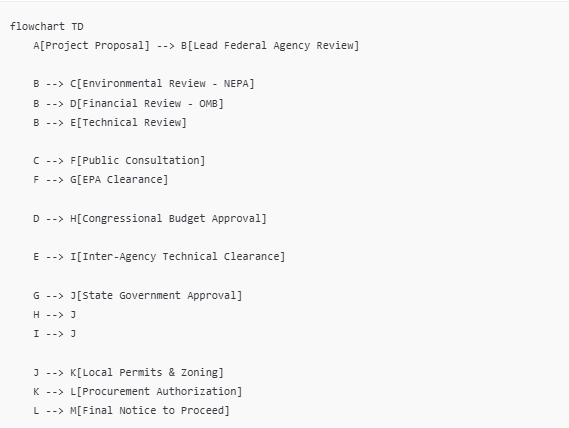
China vs US Infrastructure: Power, Speed, and Trade-Offs
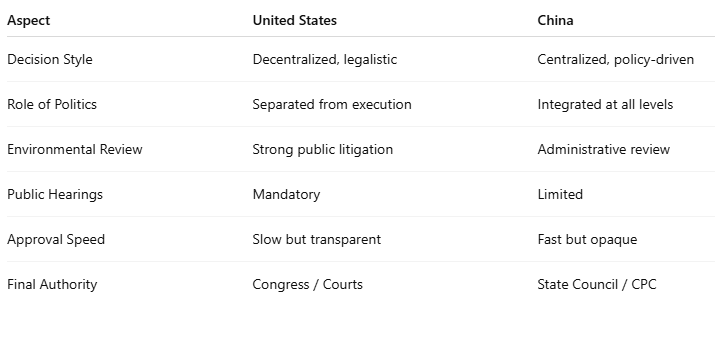
The stark contrast between China vs US infrastructure is best understood as a trade-off rather than a hierarchy. China’s system concentrates decision-making authority at the top, minimizing the number of actors who can block state priorities. Once approval is granted, implementation proceeds with remarkable speed.
The United States disperses authority across institutions precisely to prevent unilateral decision-making. Projects advance slowly because they must survive constant scrutiny and negotiation.
China’s advantage lies in throughput and scale. The US advantage lies in legitimacy and error correction. When mistakes occur, American systems are better equipped to expose and challenge them, even if doing so is costly and time-consuming.
How Sovereign Land Ownership Shapes China’s Cities
Another reason how China builds mega projects differs so sharply from the American experience is land ownership. In China, all urban land is owned by the state, while rural land is held collectively. Individuals and businesses possess usage rights that can be traded, but ultimate ownership remains public.
This arrangement gives the Chinese government extraordinary flexibility to redesign cities, relocate populations, and assemble land for large-scale development. Entire neighborhoods can be cleared and rebuilt in years rather than decades.
In the United States, land ownership is private and fiercely protected. Eminent domain exists, but it is politically sensitive and legally contested. Negotiating with thousands of property owners introduces delay, uncertainty, and cost—yet these protections are considered essential safeguards of individual liberty.
China Government Control Economy and Industrial Direction
The phrase China government control economy often carries negative connotations, but it captures an important structural reality. The Chinese state plays a direct role in shaping the trajectory of strategic industries through state-owned enterprises, policy banks, and industrial planning.
Initiatives such as “Made in China 2025” are designed to accelerate technological upgrading by coordinating investment, research, and market access. Companies operating within this system may compete with one another, but they do so within parameters set by national priorities.
In the United States, the government cannot command private corporations in the same way. Firms like Apple, Boeing, or Google respond primarily to market incentives and shareholder interests. While this fosters innovation and competition, it limits the state’s ability to pursue coordinated national industrial strategies.
China Political System vs US Democracy
At the heart of this comparison lies the broader question of China political system vs US democracy. China’s system prioritizes stability, continuity, and performance. Political legitimacy is derived largely from outcomes—economic growth, infrastructure delivery, and national strength.
The American system prioritizes participation, rights, and accountability. Legitimacy flows from process rather than performance alone. Even unpopular or inefficient outcomes are tolerated if they result from lawful, democratic procedures.
These differing foundations shape how each system approaches infrastructure. China can act decisively because opposition is limited and dissent is managed administratively. The United States moves cautiously because dissent is institutionalized and protected.
China Authoritarian Efficiency: Myth and Reality
The concept of China authoritarian efficiency is often overstated. While China’s centralized system enables rapid execution, it also carries significant risks. Poorly conceived projects can persist long after their flaws become apparent. Debt accumulation, environmental damage, and underutilized infrastructure are real challenges.
Local governments, though subordinate to the center, are not passive. They negotiate, reinterpret, and sometimes resist central directives in subtle ways. This dynamic introduces complexity that is often invisible to outside observers.
Efficiency, in this context, is situational. China excels when objectives are clear and technical. It struggles when success depends on creativity, dissent, or decentralized experimentation.
US Federalism Infrastructure Problems
Many US federalism infrastructure problems stem from the very principles Americans value most. States guard their autonomy. Local governments defend community interests. Courts enforce legal rights without political interference.
These mechanisms protect citizens but complicate national coordination. Building a single rail line can involve dozens of agencies and jurisdictions, each with distinct priorities. The result is fragmentation rather than coherence.
Ironically, when political consensus does emerge—as it did during World War II or the construction of the interstate highway system—the United States can mobilize rapidly. The problem is not capacity, but consensus.
Why China Can Plan Long Term While the US Struggles
The question of why China can plan long term ultimately comes down to incentives. Chinese leaders are rewarded for meeting development targets and maintaining stability, not for winning elections. American leaders must constantly balance long-term needs against short-term political survival.
This difference shapes risk tolerance. China is willing to accept social disruption and financial loss in pursuit of strategic goals. The United States is more cautious, prioritizing individual rights and fiscal scrutiny even when urgency demands speed.
Legitimacy: Performance Versus Process
The deepest distinction between the two systems lies in legitimacy. In China, legitimacy is performance-based. As long as living standards rise and national strength grows, the system maintains public acceptance.
In the United States, legitimacy is procedural. Citizens may criticize outcomes, but they generally accept decisions made through democratic processes.
These different social contracts explain why each country tolerates different costs—and why China vs US infrastructure outcomes diverge so dramatically.
Conclusion: Different Systems, Different Outcomes
China can build infrastructure faster than the United States because it is designed to do so. Its political system concentrates power, minimizes veto points, and prioritizes long-term continuity over pluralistic consent.
The United States cannot replicate this model without abandoning core democratic principles. Its slower pace is not a failure of governance, but the price of a system built to protect rights, distribute power, and correct errors through dissent.
The real challenge for both countries lies ahead. China must find ways to incorporate feedback without sacrificing coordination. The United States must streamline decision-making without undermining legitimacy.
This is not merely a debate about roads or railways. It is a reflection of two different answers to the same question: how much power should the state have over society in pursuit of national goals?
Liked this article? You might also find these pieces insightful: