
Inside Pakistan’s Call Center Scam Industry: A Global Perspective

The Allure of Call Centers: Opportunities vs. Risks
Call center advertisements in major Pakistani cities like Quetta, Peshawar, Karachi, Lahore, Islamabad, and Rawalpindi are ubiquitous. Billboards outside universities, colleges, and schools promise young people they can earn up to Rs. 1 lakh per month with no degree or prior experience. For many students still in their intermediate or FSC levels, these opportunities appear as a fast-track to financial independence.

Advertisement like this all round the web promising lucrative call center jobs lure young aspirants into the industry.
The Global Network of Scams: Asia to the Americas
Call center scams are not unique to Pakistan. They operate internationally, including in India, Bangladesh, Nepal, the Philippines, Indonesia, South Africa, Cambodia, and several South American countries. Reports suggest that Pakistan alone hosts over 1,000 call centers employing nearly one million people. These operations exploit a mix of unskilled youth, outdated regulation, and complex international financial systems to orchestrate large-scale fraud.

Call center scams operate internationally, with networks spanning Asia, Africa, and the Americas.
How the Scam Industry Works: Technology and Hierarchy
These operations are sophisticated and hierarchical. Frontline employees, often young and inexperienced, are tasked with making calls or sending phishing messages. Higher-level operators handle hacking, money laundering, and the distribution of stolen funds. The scam centers replicate legitimate businesses in appearance: they register as software companies or digital service providers and even offer legitimate services to mask their criminal activities.

Scam call centers replicate legitimate offices, compartmentalizing tasks to extract maximum financial gains.
Major Operations and Crackdowns: NCCIA and FIA Raids
In July 2025, the National Cyber Crime Investigation Agency (NCCIA) conducted a significant raid in Karachi, arresting 149 individuals, including Pakistanis, Chinese, Nigerians, Filipinos, Zimbabweans, Sri Lankans, and Bangladeshis. Among the arrested were 18 women working on hacking bank systems, stealing data, and extracting billions of rupees.

Raids by the NCCIA and FIA uncover multi-national teams conducting large-scale fraud operations.
The Mechanics of Fraud: AI, Phishing, and VoIP
Call center scams often target foreign countries at specific times: Australia during the day, Europe in the afternoon, and the US at night. Operations use fake VoIP systems, AI-generated voices, and impersonation of legitimate companies or banks. Fraudsters extract personal, financial, and banking data, often blackmailing victims afterward.

Fraudsters use AI-generated calls, VoIP systems, and phishing to manipulate victims worldwide.
Human Trafficking and Exploitation
Beyond financial scams, these operations involve human trafficking. Young people are recruited under the guise of legitimate jobs abroad, only to be forced into cyber fraud activities. Interpol operations in March 2025 rescued 66 victims who had been trafficked for online scams. Forced labor, extortion, and imprisonment in compounds are common practices, highlighting the industry’s human cost.

Young recruits are trafficked under false pretenses, forced into cyber fraud and extortion schemes.
Scale and Financial Impact: Billions Lost Worldwide
The global impact of call center scams is staggering. Estimates indicate that these frauds cause losses of $12–14 trillion worldwide, surpassing the GDPs of many countries combined. In the United States alone, Indian and Pakistani scammers extracted billions of dollars in 2022. In Cambodia, call centers generate an annual revenue of $19 billion, accounting for 60% of the country’s GDP.

Call center scams cause trillions in losses worldwide, impacting economies and global financial systems.
Regulatory and Legal Challenges in Pakistan
Pakistan faces significant challenges in regulating the industry. Between 2020 and 2024, 650,000 cybercrime complaints were filed, with only 200 convictions recorded—revealing a conviction rate of less than 0.1%.
Despite thousands of complaints, Pakistan’s conviction rate for cybercrime remains extremely low.
Ensuring Fair Practices: Licensing and Oversight
For Pakistan to develop as a legitimate outsourcing hub, fair business practices are essential. Licensing and strict regulation can prevent unauthorized call centers from exploiting workers and victims alike. Proper oversight ensures that outsourcing and business process management remain productive industries, contributing positively to the economy without falling prey to fraudulent activities.
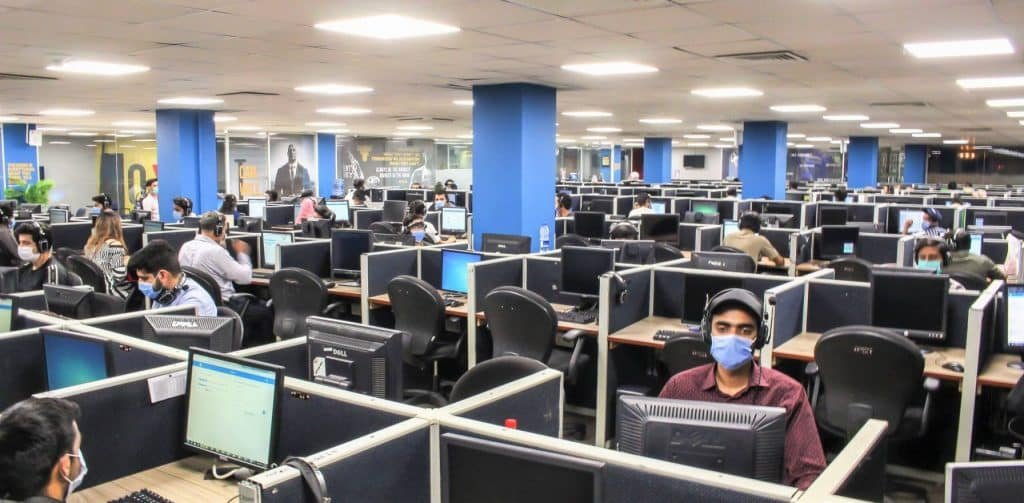
Strict licensing and regulation can transform Pakistan into a trusted hub for legitimate outsourcing services.
Conclusion: Building a Legitimate Outsourcing Hub
Call center scams in Pakistan are a microcosm of a global problem, blending technology, greed, and human exploitation. While opportunities exist for young people in the legitimate outsourcing sector, the lure of easy money has fueled a vast underground industry with far-reaching consequences. Addressing this challenge requires coordinated legal frameworks, technological safeguards, and strict enforcement. Only then can Pakistan emerge as a trusted hub for legitimate outsourcing and digital services.
Liked this article? You might also find these pieces insightful: